


Online casino licensing answers two separate questions. The first is who supervises the casino: which regulator checked the company, holds its licence conditions and can take the licence away. The second is whether the casino may serve players in your country. An offshore licence from Curacao, Malta or Anjouan answers the first question. Only your own country’s regulator answers the second. A casino can hold a valid Curacao licence and still be blocked in Poland, Switzerland or Spain, because those countries license casinos themselves.
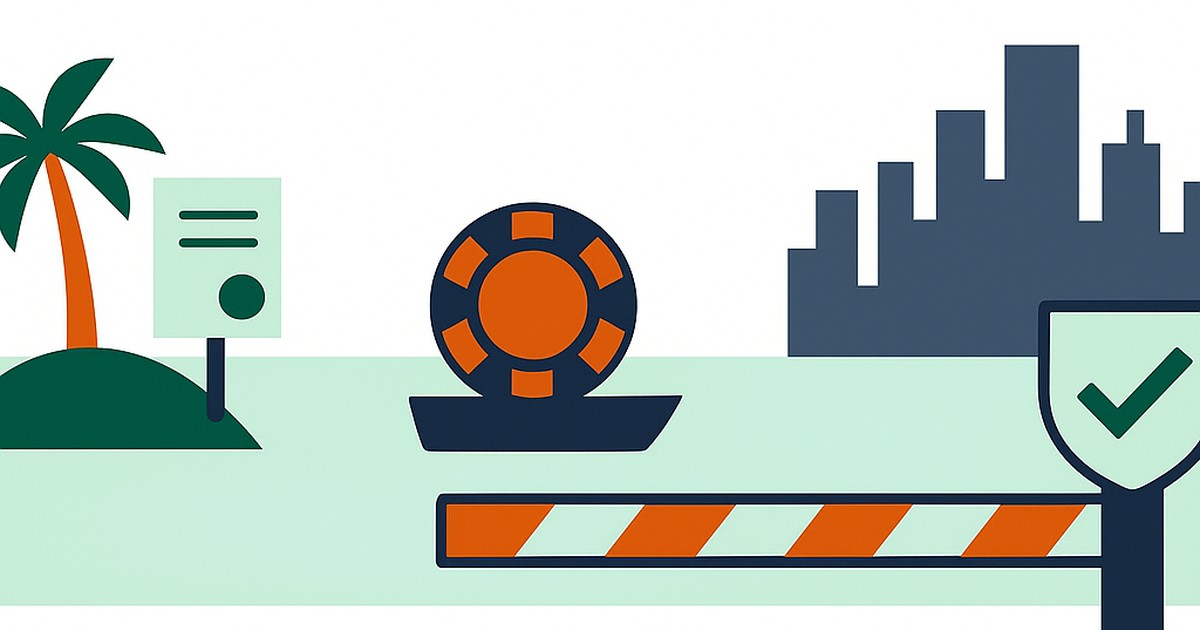
Offshore licences and local licences
| Offshore licence | Local licence | |
|---|---|---|
| Examples | Curacao CGA, Malta MGA, Anjouan, Kahnawake | Spain DGOJ, Poland Ministry of Finance, Sweden Spelinspektionen, Switzerland ESBK |
| What it shows | The operator is registered with a regulator and accepted its licence conditions | The operator may offer gambling to players in that one country |
| Where it counts | Countries without their own licensing system | Only the country that issued it |
| What happens elsewhere | In a country with its own regulator the casino is unlicensed and can be blocked | No effect outside that country |
Three kinds of markets
Every country treats online casinos in one of three ways. The kind of market decides what a licence is worth there.
Licensed market: Poland and Switzerland
A licensed market has a gambling law, a regulator and local licences. A casino without the local licence is unlicensed there, whatever offshore licence it shows.
- Poland. Totalizator Sportowy, the state company, holds the monopoly on online casino games. Other companies can only get permits for online betting. The Ministry of Finance keeps a Register of Domains of blocked gambling sites, which listed 38,403 domains when we read it on 4 November 2026. See the Poland gambling license page.
- Switzerland. The ESBK lists the online casinos it has authorised, and two regulators publish block lists of unauthorised sites. The editions of 25 August 2026 hold 4,186 blocked domains together. See the Switzerland casino license register.
Partial or pending licensing: Ireland and New Zealand
Here a law exists, but it does not yet license online casinos.
- Ireland. The Gambling Regulation Act 2024 created the Gambling Regulatory Authority of Ireland. GRAI has licensed online betting since 1 July 2026, and it has issued no licence for online casino games. It says gaming licences will open during 2027 and 2028. Details on the Ireland gambling licence page.
- New Zealand. The Online Casino Gambling Act 2026 came into force on 1 May 2026. Eleven entities won the right to apply for 15 licences, and the Department of Internal Affairs expects to grant the first licences from early 2027. From 1 December 2026 an online casino that has not applied must stop serving New Zealand players. Details on the New Zealand online casino page.
No regime: Costa Rica
Some countries have no online gambling licence at all. Costa Rica is the best known. Companies there hold ordinary corporate registration and a municipal permit, and Law 9050 of 2012 taxes firms that process betting data. None of this is a gaming licence. A casino that claims a “Costa Rica gaming licence” claims something that does not exist. Read the Costa Rica licence explainer.
What changed in the offshore licences
Curacao: one regulator since December 2024
For years most “Curacao licences” were sub-licences sold by four private master licence holders. The National Ordinance on Games of Chance, the LOK, ended that system on 24 December 2024. The Curacao Gaming Authority is now the only body that issues licences. Old licences were turned into provisional LOK licences, and the orange seal of the old system expired on 15 October 2025.
A B2C licence now costs EUR 47,450 a year in treasury and supervisory fees. The CGA registry of 20 October 2026 lists 666 licences, of which 209 are final licences without an end date. To check one, open cert.cga.cw/token?id= with the last part of the licence number and confirm that the status is Active and the casino’s domain is listed. Full steps on the Curacao license check page.
Supplier deadline, unconfirmed. Trade press reported in June 2026 that the CGA set 24 December 2026 as the end of the two-year transition for suppliers. According to those reports, suppliers based in Curacao need a CGA supplier licence by then, foreign suppliers of critical services must register, and CGA licensees may not work with unregistered suppliers. We could not find this announcement on the CGA website on 17 November 2026, so treat the date as unconfirmed and possibly wrong until the CGA publishes it.
Malta: Article 56A before the EU Court of Justice
The MGA licence is the most established offshore licence in Europe. In 2023 Malta added Article 56A to its Gaming Act, known in parliament as Bill 55. It tells Maltese courts to refuse enforcement of certain foreign judgments against MGA licensees, such as a judgment from another EU country ordering a casino to repay a player because it had no local licence there.
The European Commission opened an infringement procedure against Malta over this provision on 18 June 2025, case INFR(2025)2100. Its letter of formal notice says Malta breaks the EU regulation on jurisdiction and the recognition of judgments, Regulation (EU) 1215/2012, by obliging its courts to systematically refuse judgments from other member states against Maltese-licensed gaming companies. The Commission says the rule shields the online gaming sector from cross-border litigation. Malta had two months to reply, and the next possible step is a reasoned opinion.
On 23 April 2026 Advocate General Nicholas Emiliou gave his opinion in case C-683/24. His main view is that the Austrian court’s question is inadmissible. If the Court of Justice disagrees, he proposes to find the provision manifestly incompatible with the Brussels I bis Regulation on the recognition of judgments. The opinion does not bind the Court, and its judgment comes later. Either way, an MGA licence gives no right to serve a country that licenses casinos itself. See the Malta gaming license page.
Anjouan: a licence its own state does not recognise
Many crypto casinos now show an Anjouan licence. Anjouan is one of the three islands of the Union of the Comoros. The Central Bank of the Comoros calls the Anjouan Offshore Finance Authority and its agent fictitious structures and says only the Central Bank may license financial institutions in the country. The licence fee is EUR 17,828 a year. Read the Anjouan licence and Comoros central bank explainer.
A licence is a status on one day
Licences are suspended, revoked and left to expire, and the regulators publish these changes. The CGA registry edition of 2 November 2026 moved three Curacao licences to revoked as of 27 October 2026. In Sweden, the appeal court upheld SEK 44 million in penalties against the two bet365 companies in October 2026 (bet365 Sweden deposit fines). A brand that was licensed last month may not be licensed today, so a licence check has a date.
Games and suppliers are licensed too
Regulators also license the companies behind the games. Malta issues a B2B Critical Gaming Supply licence for game content and control systems, and Curacao issues a B2B supplier licence for platforms and software. A casino with a local licence may only offer games approved in that country, so its game lobby is often smaller than an offshore casino’s.
How to check a casino licence
- Find the licence number and the company name in the casino footer.
- Open the register of the regulator named there, never only the seal on the casino site.
- Confirm that the licence is active and that the casino’s exact web address is listed on it.
- Check whether your own country licenses casinos. If it does, look for the brand in that country’s register too.
Our search does steps 2 to 4 in one go across 39 official registers and block lists. Type a casino name, a web address or a licence number on the homepage, or follow the full guide to checking a casino license.